
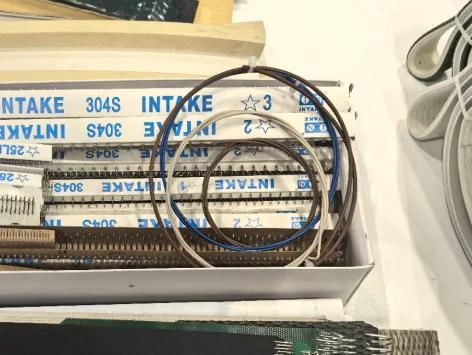
Conveyor belt joints operate under repeated bending, tension, and movement as belts travel around pulleys and through different sections of a conveyor. For manufacturers and maintenance teams, choosing the right joining components is therefore important not only for splice strength but also for how the joint behaves during operation. A properly selected conveyor belt hinge pin can connect the two sides of a hinged mechanical fastening system while allowing controlled articulation as the belt moves.
Hinged mechanical splices are designed differently from permanently bonded joints. In suitable systems, removing the hinge pin allows the belt ends to be separated without completely removing the fastening components. This can be useful for maintenance operations that involve belt inspection, replacement, or length adjustment. Flexco, for example, describes hinged fastening systems as suitable for applications where joints need to be separated by removing the hinge pin.
How a Conveyor Belt Hinge Pin Supports Joint Flexibility
The hinge pin is a relatively small component, but its role within a mechanical splice is significant. It passes through the loops or hinge sections of the fasteners and allows the two belt ends to move around the conveyor’s pulley path. This articulation helps the joint accommodate repeated bending instead of functioning as a completely rigid connection.
For belt manufacturers, this design can provide useful flexibility when developing products for different conveyor configurations. The appropriate conveyor belt hinge pin must still be matched with the fastening system, belt construction, and operating conditions. A pin should not be selected independently simply because its diameter appears suitable.
Maintenance requirements are another reason to consider hinge-pin design. In compatible fastening systems, removing the pin can separate the belt joint and provide access for inspection or belt replacement. This can be particularly practical for businesses managing multiple conveyor belts where maintenance teams need repeatable procedures rather than specialized permanent splicing for every repair.
Material Selection for Stainless Hinge Pins
Material selection becomes more important when conveyor belts operate in environments exposed to moisture, cleaning agents, or other potentially corrosive conditions. Buyers evaluating stainless hinge pins should consider the material, dimensions, fastening system, and operating environment together.
Intake’s official Hinge Pin specification lists 304S as the primary material, with a product weight of 0.72 kg and packaging of 12 pieces per box. The specification table also provides several configurations. C047 uses a Φ2.3 wire diameter, C058 uses Φ3.2, C069 uses Φ1.6, CT080 uses Φ1.6, G091 uses Φ1.2×3, and S055 uses Φ1.6. The listed material configurations include oxygen-plastic core carbon steel, silicone, nylon, and stainless steel with Teflon.
These details are relevant to B2B procurement because “stainless” alone does not define whether a hinge pin is suitable for a particular fastening system. Diameter, construction, material combination, and compatibility should be confirmed against the belt and fastener specification before an order is placed.
For applications where corrosion resistance is a purchasing consideration, stainless hinge pins can therefore be evaluated as part of a broader material-selection process. The decision should be based on the actual environment and the manufacturer’s published specifications rather than on material labels alone.
Integrating Hinge Pins With the Complete Fastening System
A hinge pin should be treated as one component within the complete mechanical splice. The fastener, belt, pin, and installation method need to work together. Industry technical guidance recommends considering belt tension, belt thickness, and pulley diameter when selecting mechanical fastening systems.
Intake’s current product portfolio includes Carded Wire Belt Fasteners, Reinforced Wire Hook Belt Fasteners, the INTAKE CR Series, Hinge Pins, a Hydraulic Belt Fastener Machine, and a Manual Roller Lacer. This broader range allows belt manufacturers and distributors to evaluate fastening components alongside installation equipment instead of treating the hinge pin as an isolated spare part.
Installation quality also matters. The belt ends need to be prepared correctly, the fasteners aligned across the belt width, and the hinge pin installed without damaging the fastening components. After installation, the joint should be inspected for alignment and appropriate clearance from surrounding conveyor components.
For distributors and maintenance departments, keeping compatible replacement pins available can also make routine servicing more predictable. Inventory can be organized around specific fastener models and dimensions rather than relying on generic replacement parts.
Applying Hinge Pin Selection to Conveyor Maintenance
For manufacturers, distributors, and maintenance teams, the evaluation of a conveyor belt hinge pin should focus on the complete application rather than the component alone. Belt construction, fastener type, pin dimensions, pulley configuration, and operating environment should be reviewed together. Where environmental exposure makes material selection important, stainless hinge pins can be considered when their specifications match the intended fastening system.
Intake provides hinge pins alongside multiple mechanical belt-fastening products and installation equipment. Its published product information gives procurement teams specific data on material, weight, packaging, wire diameter, and available configurations, supporting more structured product evaluation.
Ultimately, hinge-pin selection is part of the overall belt-joint design. Matching the pin with the appropriate fastener and operating conditions can help manufacturers establish a more flexible approach to conveyor belt maintenance, replacement, and servicing. For B2B buyers, evaluating the complete fastening system rather than one component at a time provides a more practical basis for purchasing and long-term maintenance planning.
