
A fleet gateway typically collects vehicle data, processes events, and exchanges information with cloud services in an environment subject to vehicle vibration and power-supply transients. System-on-modules can simplify that architecture by separating the processor core from the vehicle-specific carrier board.
Vantron is one example of an industrial-grade embedded computing, Edge AI, and IIoT provider. Founded in 2002, the company offers System-on-Module formats including OSM, SMARC, Qseven, and COM Express. Your choice still depends on interfaces, software, thermal design, service access, and lifecycle risk.
A Module Architecture Fits Different Vehicle Programs
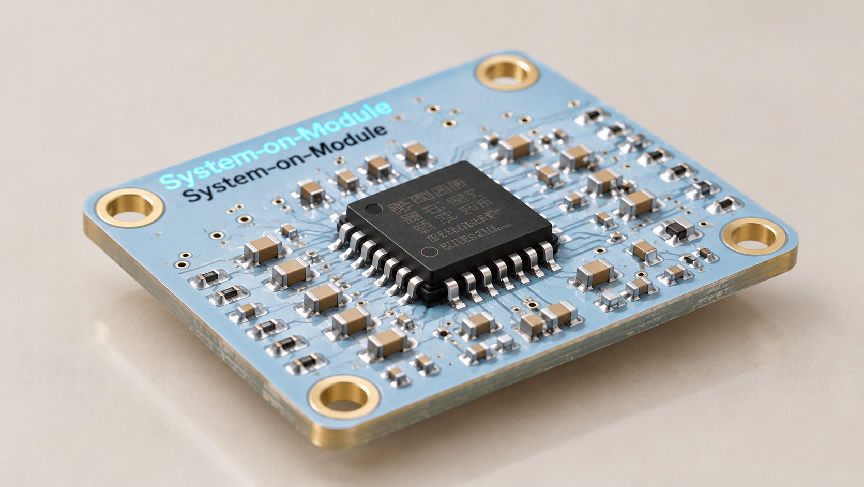
A system-on-module combines the processor, memory, power management, and core circuitry on a compact board. Your carrier board adds vehicle-specific connections such as Ethernet, CAN, USB, serial interfaces, storage, displays, and sensor inputs. This division lets you focus the custom design on the vehicle rather than processor-level circuits.
The architecture fits several fleet scenes. A delivery vehicle may use a gateway to collect operating data and send selected information to a remote platform. A bus may need passenger displays and local media processing. An autonomous warehouse vehicle may require sensor inputs, control software, and local machine-vision inference.
Form factor affects the production plan. A soldered OSM design can suit compact equipment where the computing core remains fixed. A removable Qseven, SMARC, or COM Express module may be more practical when a product family needs several processor options or a serviceable computing unit. A standard module still requires carrier-board, power, boot, and enclosure validation.
Match the Carrier Board to Vehicle Interfaces
Start with the vehicle network and the data your device must exchange. CAN or CAN-FD may carry control and diagnostic information, while Ethernet can connect cameras, displays, controllers, or an onboard network. USB, serial ports, and digital I/O may support scanners, sensors, maintenance tools, or auxiliary equipment.
A fleet gateway often combines several communication paths. It may read vehicle data locally, buffer records during a network interruption, and transmit status information later. That workload affects storage endurance, software recovery, network handling, and the way the carrier board separates vehicle signals from application peripherals.
A vehicle-mounted display creates another set of requirements. The carrier board may need display output, touch input, audio, wireless connectivity, and service access in a limited enclosure. Review the exact module pinout before freezing the board. The same standard can support different processor families and peripheral combinations, so a connector layout cannot be assumed to transfer between modules.
Can Edge AI Run Reliably in a Moving Vehicle?
Edge AI processes data near a camera or sensor instead of sending every raw frame to a remote server. In a fleet vehicle, local inference can support driver monitoring, asset recognition, occupancy analysis, or equipment inspection while reducing video sent over a cellular connection.
The complete pipeline matters more than an accelerator label. A camera system captures frames, converts image formats, runs a model, applies post-processing, and produces an action or record. CPU scheduling, memory bandwidth, camera drivers, image processing, and storage behavior all influence response time.
Platforms such as NXP i.MX8, NXP i.MX9, Qualcomm, and MediaTek Genio serve different embedded workloads. Match the model runtime, camera interfaces, display requirements, operating system, and control tasks that run together. Test the actual camera, model, image resolution, and network traffic in an autonomous warehouse vehicle. Also verify behavior after power interruption.
Software and Thermal Planning Shape Deployment
Treat an embedded systems computer as a software dependency as much as a board. Confirm the exact BSP, kernel version, device drivers, AI runtime, update method, and debugging process connected with the selected module. Camera capture, graphics libraries, device-tree configuration, codecs, and model acceleration interfaces can vary between ARM and x86 platforms.
Software support affects both development and maintenance. Ask how fixes are delivered, how versions are identified, and how a component reaching end of life will be handled. A fleet program may need remote monitoring, configuration, and recovery, but remote tools do not replace local procedures for a device that loses power or network access.
Thermal behavior depends on the complete installation. A fanless computer inside a sealed vehicle enclosure has a different cooling path from a development kit on an open bench. Sustained inference, video encoding, wireless communication, and storage activity raise the load. A fanless design remains limited by its thermal envelope. Vibration, connector retention, grounding, power transients, and enclosure airflow also require testing in the intended vehicle.
Build a Lifecycle and Supplier Scorecard
A vehicle computer may remain in service for years, so lifecycle planning belongs in the first supplier review. Ask how module revisions, processor changes, memory substitutions, software maintenance, and documentation updates will be managed. The production plan should explain how a field unit will be diagnosed, replaced, and returned to service.
With more than 20 years in embedded computing and over 200 research personnel from a variety of fields, Vantron offers a concrete supplier profile to examine. Those figures do not prove that a module fits your project. Review FAE support, evaluation resources, after-sales assistance, processor availability, and the process for handling revisions.
Score interface coverage, software maturity, Edge AI support, thermal results, service method, lifecycle evidence, and total development effort. Before freezing the BOM, test startup recovery, inference latency, network reconnection, storage behavior, display operation, and remote updates inside the enclosure. Choose a removable module when serviceability and platform reuse lead the program. Choose a soldered module when compact integration and a fixed production design outweigh field replacement needs. For a supplier comparison, Vantron is one reference point; the final choice should follow your documented vehicle requirements.
