
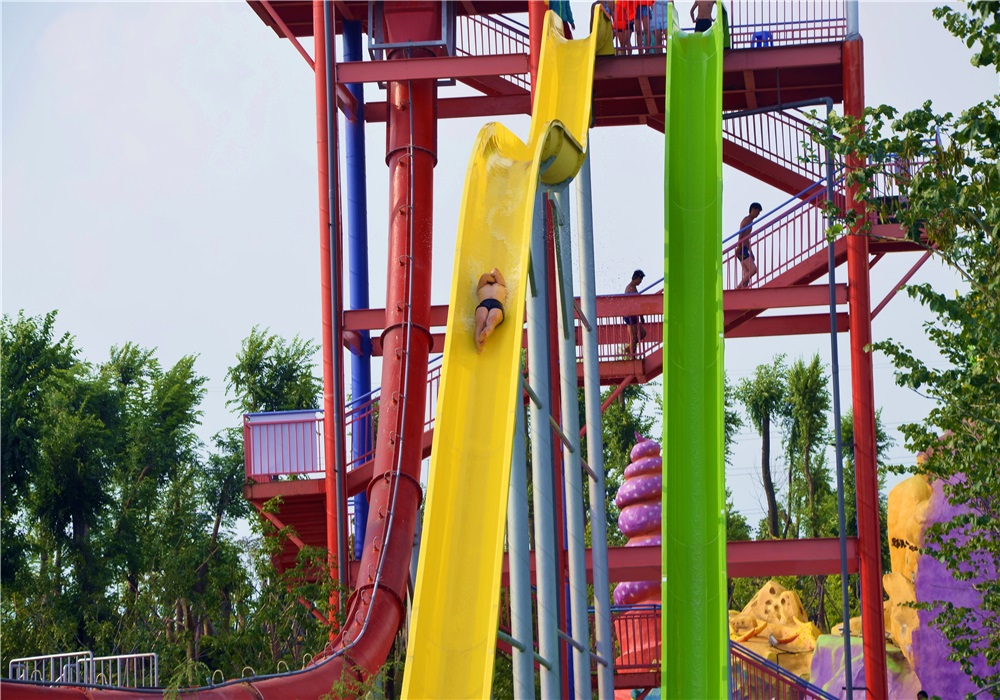
A body slide is a water slide that carries a rider along its channel without an inflatable tube or raft. The person follows the descent directly, with the route shaping the movement from the starting position to the landing arrangement.
For a water-park investor, that definition answers one question about the attraction, while leaving several others open. The starting method, bends, enclosed sections and finish still determine which individual riding experience is being proposed and where it belongs within the park.
Separate the Rider Format from the Shape
The words “body water slide” identify how people ride, rather than prescribing one outline. A direct descent and a winding route can both carry an individual without an inflatable. Their shared rider format does not make their movement or starting arrangements identical.
Conversely, serpentine slides describe a winding form. The name directs attention to successive bends, but the equipment specification still has to identify how each person travels. A curved silhouette alone cannot establish whether a lane uses a body, mat or raft format.
Open and enclosed sections describe another feature: the rider’s surroundings along the route. A covered channel may interrupt outward views, while an open section exposes them again. Neither description replaces the need to state the riding equipment and instructions for that particular lane.
These distinctions matter when several photographs appear together in a product range. Similar colours or a shared tower can conceal different arrangements. The investor needs the proposed lane identified before attaching assumptions about rider grouping, preparation or equipment handling to its appearance.
Read the Descent as a Sequence
Gravity drives descent, with water assisting movement. Slopes, bends and buffer sections shape successive parts of the ride. Starting height gives the route a vertical reference, but does not describe that entire sequence. Two configurations can start at similar levels while offering different changes of direction and different finishes.
Kamikaze provides a specific example within Jinchao’s range: one rider uses a 0.8 m channel from a starting height of 5–15 m. Its published approximate capacity is 500–600 riders per hour. Those figures describe the named speed-slide configuration rather than every individual descent.
A water park manufacturer can also distinguish a conventional start from a launch chamber. Aqua Loop uses a controlled capsule and an enclosed translucent route, with a 12–17 m starting-height range and a 0.8 m lane accommodating one rider.
Flying Fish offers another chamber departure, triggered by an operator, using a 0.8 m flume and starting heights of 8–15 m. Comparing these body slides means examining the actual start and subsequent route, rather than treating a chamber as a complete ride description.
Check Each Lane in a Combined Attraction
Jinchao’s Loop Water Slide Combination brings open routes, enclosed sections and double-raft options into a wider combination concept. Its standard starting-height range is 5–15 m, while customised solutions extend from 3–19 m. The combination name therefore covers several choices requiring a specific configuration.
The published flume widths are 0.8 m or 1.4 m, with one- or two-person configurations and approximate capacity of 300–400 riders per hour. A width, rider number and capacity range still need their proper connection to the lane proposed for the project.
Within a combined structure, serpentine slides can contribute a winding sequence alongside other routes. The investor can examine which bends and transitions belong to each lane. Sharing a structure does not mean that every route offers the same movement or uses the same riding equipment.
Some selected lanes may use mats or rafts, while others operate without them. That distinction avoids a common misunderstanding: a combination containing an individual body route is not necessarily composed entirely of that format. The final lane arrangement settles the description.
Keep the Human Tasks in View
Dispatch control, rider instructions, supervision and inspections remain part of operation. Staff also need clear visibility of the landing arrangement. Removing an inflatable from the ride does not remove the people responsible for checking readiness at the start and clearance at the finish.
A practical benefit of body slides is the absence of a separate inflatable collection, carrying, storage and return cycle. That benefit concerns equipment movement. Stairs, waiting riders, operating positions and exits still occupy space and require coordination within the attraction’s daily routine.
The operating brief can accompany Jinchao‘s customised design work, with dispatch and landing positions marked beside the selected route. Production is based at an approximately 36,000 m² factory; the water park manufacturer has completed more than 300 projects across its wider equipment business.
Choose the Experience That Fills the Gap
An investor may discuss an individual attraction with a water park manufacturer where the existing line-up needs that form of participation. A speed descent, a winding route and a chamber start offer different subjects for that discussion, even though none requires a shared raft.
The review of serpentine slides can then concentrate on the intended turns and their relationship with the available site. A winding form does not establish a universal intensity, footprint or operating capacity. Those answers come from the chosen route and its surrounding arrangement.
In the finished park, the distinguishing feature remains how the person rides. Different starts, curves and finishes can sit under that definition. The chosen lane can then be explained accurately to operators and guests, with its riding equipment and instructions unambiguous.
