
Choosing garment printing equipment is a significant decision for custom apparel shops, print-on-demand businesses, and promotional merchandise suppliers. The right machine must produce consistent designs, fit the available workspace, and support a profitable order workflow. When comparing a direct to garment printer for sale, buyers should look beyond the initial price and examine print quality, fabric compatibility, pretreatment requirements, maintenance, and technical support. These factors help determine whether a printer can meet both current demand and future business needs.
Assess Print Quality and Production Consistency
Print quality directly affects customer satisfaction, particularly for detailed illustrations, multicolor graphics, photographs, and small lettering. Buyers should evaluate the printer’s resolution, color reproduction, white-ink performance where applicable, and ability to maintain consistent results across repeated jobs. Requesting sample prints is more useful than relying on promotional images, which may not reflect actual production conditions.
Testing should cover the garment types the shop expects to print most often. Cotton T-shirts, blended fabrics, and dark garments can behave differently during printing and finishing. A reliable evaluation includes checking fine details, color transitions, ink coverage, and the final feel of the printed design. Wash testing under appropriate conditions can also help assess durability, although results depend on pretreatment, curing, ink, and fabric composition.
Production consistency matters just as much as the quality of a single sample. Shops fulfilling repeat orders need dependable color output and predictable results from one batch to the next. Ask suppliers how calibration, maintenance, and recommended operating conditions affect consistency before making a purchasing decision.
Understand Pretreatment and Printing Requirements
Direct-to-garment (DTG) printing deposits ink directly onto fabric. Depending on the garment, ink system, and desired result, pretreatment may be necessary to help the ink perform properly, especially when printing white ink on dark garments. Pretreatment application and drying can add labor, equipment, and processing time to the production workflow.
For a small shop, simplifying these steps may improve throughput and reduce handling. However, buyers should confirm exactly which stages a machine automates and which still require operator attention. An integrated system does not automatically eliminate every preparation or finishing requirement.
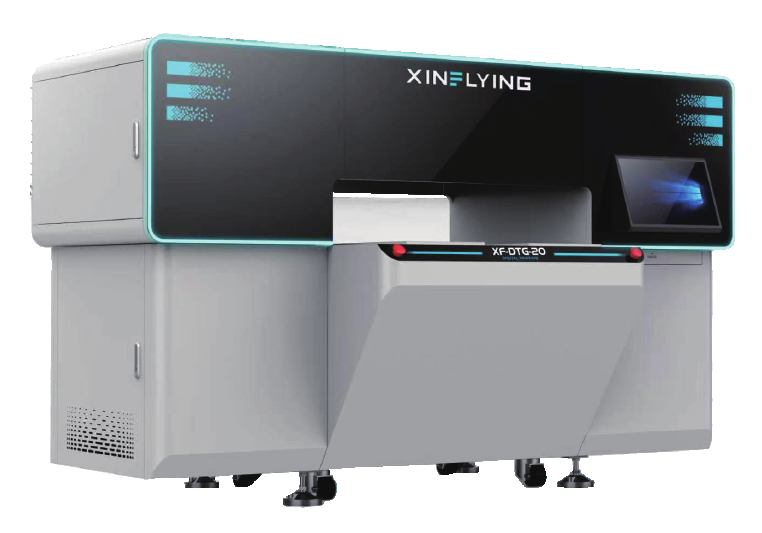
Xinflying’s XF-DTG-20-2I16A1+4I32A1 is presented as a pretreatment-and-printing all-in-one direct-to-garment printer. Its supplied product information highlights one-click printing without separate preprocessing, a double-suction configuration intended to improve efficiency, and intelligent humidification to help maintain suitable environmental humidity. Buyers should request a demonstration to understand the complete workflow and verify which garments and settings are supported.
Match Printing Capacity to Your Order Volume
A printer should be evaluated against realistic daily and monthly demand rather than its fastest advertised operating mode. Consider the number of garments ordered per day, average design size, proportion of dark garments, and frequency of artwork changes. These factors influence actual throughput and determine whether a machine can handle peak periods without creating production bottlenecks.
When reviewing a direct to garment printer for sale, ask for documented production rates under conditions similar to the shop’s typical orders. Clarify whether quoted speeds include loading, pretreatment, curing, garment changes, and routine maintenance. A machine with a high theoretical speed may deliver less finished output if each job requires extensive manual handling.
Also consider how orders move between printing, curing, inspection, and packaging. Efficient scheduling, prepared artwork, and standardized quality checks can improve output without requiring a larger machine. Shops should compare complete production workflows rather than print speed alone.
Review Maintenance and Environmental Controls
DTG printers require regular maintenance to keep ink flowing correctly and maintain print quality. White ink can be particularly demanding because pigment may settle without suitable circulation and maintenance procedures. Buyers should ask about cleaning routines, printhead protection, ink circulation, and the availability of replacement components. Understanding these requirements in advance helps shops plan labor and reduce avoidable downtime.
Environmental conditions also influence operation. Temperature and humidity can affect ink behavior, garment preparation, and print consistency. The XF-DTG-20-2I16A1+4I32A1 features intelligent humidification designed to help maintain suitable printing conditions. A shop should still follow the manufacturer’s recommended operating range and establish a regular inspection schedule.
Compare Total Ownership Costs and Supplier Support
The purchase price is only one part of the investment. Calculate expected expenses for ink, pretreatment solution, cleaning supplies, curing equipment, electricity, replacement parts, and labor. Also consider the costs of rejected garments, training, and production interruptions. A detailed cost estimate helps businesses determine whether the machine can support their target margins.
When evaluating a direct to garment printer for sale, request a written quotation that identifies the machine configuration, included accessories, warranty terms, delivery arrangements, and support services. Ask whether remote troubleshooting, operator training, and spare parts are available. These details matter particularly for shops that cannot afford extended production delays.
A reliable Xinflying DTG printer manufacturer should be able to clarify technical specifications and explain how the equipment fits the buyer’s production requirements. Businesses should verify performance through sample printing and practical demonstrations instead of relying exclusively on marketing descriptions.
Make the Purchase Decision with Confidence
The best DTG investment balances print quality, practical throughput, preparation requirements, maintenance, and long-term operating costs. Shops should test representative garments, confirm the complete production workflow, and assess supplier support before committing to new equipment.
Xinflying’s XF-DTG-20-2I16A1+4I32A1 is worth evaluating for businesses interested in integrated pretreatment and printing, simplified operation, and intelligent humidification. By comparing verified specifications and actual workflow performance, buyers can select equipment that supports reliable custom apparel production and sustainable business growth.
