
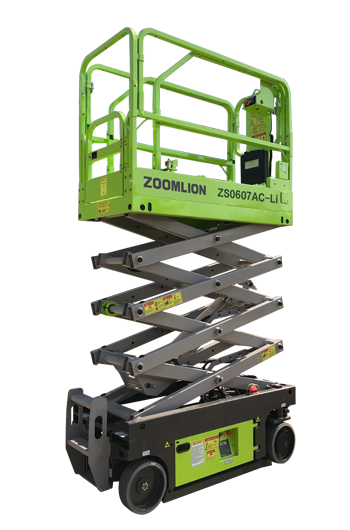
An electric scissor lift can provide efficient vertical access inside warehouses, factories, retail buildings, airports, and other facilities. Yet working height is only part of the selection process. For indoor projects, compact stowed dimensions can determine whether equipment reaches the work zone at all. Width, length, height, turning space, and floor conditions should therefore be evaluated before equipment is ordered or mobilized.
Access Starts Before the Machine Is Raised
Indoor projects often contain narrow doors, corridors, loading areas, production lines, and fixed installations. A machine that fits the working area may still struggle to reach it if its stowed width exceeds a doorway or if its overall length makes turning difficult. Route measurements should therefore begin at the delivery entrance and continue to the final operating position.
A MEWP mobile elevating work platform must be considered as part of the building’s logistics. Measure clear openings rather than relying on nominal door dimensions. Check corners, columns, shelving, barriers, ramps, and temporary obstructions. These measurements help establish whether the equipment can travel through the facility without requiring expensive dismantling or route modifications.
Why Width Matters So Much Indoors
Overall width is often the first specification procurement teams should compare. A narrow chassis can make a significant difference when equipment must pass between storage racks, production equipment, walls, or permanent building structures. Platform width, meanwhile, describes the work area and should not be confused with the machine’s transport envelope.
The route also needs sufficient clearance for steering corrections. Even when the machine is narrower than the doorway, a tight approach angle can make entry impractical. Teams should therefore record the narrowest passage, turning radius, and available maneuvering space rather than evaluating width as an isolated number.
Check Overall Height and Length
Stowed height becomes important when the machine moves beneath doors, beams, sprinkler systems, ductwork, or other overhead structures. A route survey should compare the machine’s overall height in its transport configuration with the lowest permanent or temporary obstruction along the path.
Overall length matters at corners, elevators, loading areas, and congested work floors. A compact machine may require less maneuvering space and reduce interference with surrounding operations. For projects involving multiple access zones, these dimensions can affect how quickly equipment can be repositioned between tasks.
Consider Floor and Operating Constraints
Indoor access is not only a dimensional issue. Procurement teams should confirm floor loading, surface condition, slope limitations, and clearance around the intended work position. Construction debris, uneven transitions, temporary coverings, and damaged flooring can change the practical suitability of an access route.
Electrical equipment is commonly considered for indoor applications because it avoids onsite diesel exhaust from the lift itself. However, battery charging arrangements, operating duration, and facility rules should still be included in the equipment requirement. The selected machine should match both the physical building and the planned working cycle.
Connect Compact Design With Productivity
Compact dimensions can reduce the amount of preparation required before a machine reaches the work area. When equipment can move through existing access points, teams may avoid removing barriers, relocating fixtures, or creating alternative routes. This can simplify scheduling, particularly in facilities that remain partially operational during maintenance or installation work.
A smaller footprint may also help maintain separation from pedestrians and other equipment. Even so, compactness should not become the only selection criterion. Working height, platform capacity, gradeability, turning radius, and the actual task all need to be considered together before procurement.
The ZS0607AC-Li for Indoor Access
The ZS0607AC-Li from Zoomlion Access is an electric scissor lift designed for jobs requiring compact access equipment. Its official specification lists 7.8 m indoor and 6.4 m outdoor working height, with a 230 kg platform capacity. The machine measures 1.85 m in overall length and only 0.76 m in overall width, making those dimensions particularly relevant for indoor route planning.
Its 1.79 m overall height with rails down can also help when assessing restricted routes. The specification lists a 1.65 m platform length, 0.74 m platform width, 0.91 m platform extension, and 1.37 m wheelbase. These measurements give procurement teams concrete figures for checking doors, corridors, positioning areas, and work-zone access.
Key Specifications Buyers Should Review
The ZS0607AC-Li uses a 135 Ah lithium-ion battery and a 24 V/30 A charger. It has a listed gross weight of 1,455 kg, a 4 km/h stowed drive speed, and a 0.8 km/h raised drive speed. Its inside turning radius is 0.1 m and outside turning radius is 1.6 m, while gradeability is specified at 25%.
For an indoor MEWP mobile elevating work platform, these figures should be reviewed alongside building-specific restrictions. The product page also highlights IP67-rated waterproof protection for the AC wheel motors, lithium-ion battery operation down to -20°C, lubrication-free knuckles, and a maintenance-free AC motor system.
How Zoomlion Access Fits Indoor Projects
Zoomlion Access states that their portfolio includes more than 100 MEWPs across five categories, including scissor lifts, telescopic boom lifts, articulating boom lifts, spider lifts, and telehandlers. Their product information also lists electric scissor lift ranges from 6 m to 14 m in working height, providing different configurations for projects with varying access requirements.
For buyers evaluating an electric scissor lift, their specifications provide a practical starting point for comparing machine size with site constraints. The ZS0607AC-Li combines a 0.76 m overall width with a 1.85 m overall length, giving facilities teams measurable dimensions to place alongside doorway sizes, corridor widths, turning areas, floor requirements, and the required working height.
