
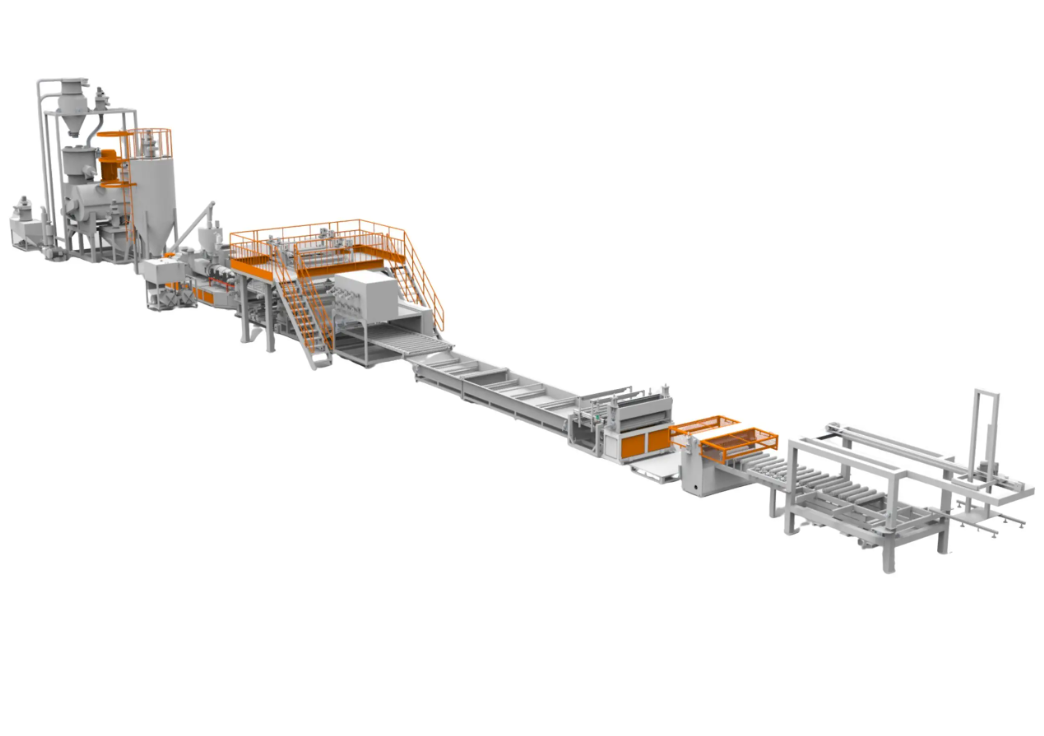
Boyu has developed long-term engineering experience in flooring equipment, especially for projects involving thin-layer SPC materials. In the design of a spc flooring machine, the focus is placed on melt stability, screw performance, and consistent sheet forming for reduced thickness requirements. Ultra-thin SPC production usually requires tighter process control compared with standard flooring lines, particularly in temperature distribution and material flow behavior. They also integrate modular automation concepts to support continuous industrial operation with stable output performance across different production environments.
Extrusion System Design for Thin SPC Structures
In modern production setups, the spc flooring extrusion line plays a central role in determining the uniformity of ultra-thin panels. Boyu applies controlled heating zones and optimized die structures to maintain stable extrusion pressure during processing. The spc flooring extrusion line is also configured with PLC-based control logic, allowing operators to adjust parameters based on raw material variations. At the same time, they reference engineering principles from LVT flooring extrusion systems to support compatibility with multi-layer flooring structures. A properly designed line ensures that thickness deviation remains within controlled industrial ranges during continuous manufacturing cycles.
Key Engineering Factors for Ultra-Thin Output
Designing a reliable spc flooring machine for ultra-thin products requires precise coordination between mechanical and thermal systems. Screw geometry, cooling speed, and pressure balance must work together to avoid deformation during forming. Boyu integrates accumulated engineering knowledge from over two decades of industrial equipment development to improve process stability. The spc flooring extrusion line must also maintain synchronized operation between feeding, extrusion, and calibration units to ensure consistent sheet quality. Additionally, energy efficiency and reduced maintenance requirements are considered during system configuration to support long-term industrial use. The spc flooring machine structure is also optimized for controlled output under continuous production conditions.
Conclusion
In summary, the design of a spc flooring machine for ultra-thin SPC products requires careful coordination of extrusion control, thermal stability, and automation systems. Boyu applies structured engineering experience to ensure that production requirements remain consistent across different applications. The spc flooring extrusion line configuration further supports stable thickness control and continuous operation efficiency. Through modular equipment design and industrial process optimization, they provide a practical approach for manufacturers working with ultra-thin SPC flooring production systems.
